Cerebral Palsy: Treatment and Management
Article Sidebar
Main Article Content
Cerebral palsy is a lifelong condition, but treatment can improve movement, comfort, communication, independence, and participation in everyday life. There is no single treatment because cerebral palsy affects each person differently. Management may include physical, occupational, and speech therapy, medicines for muscle stiffness or involuntary movements, assistive devices, injections, and surgery. Other health problems such as pain, seizures, feeding difficulties, and hip problems may also need treatment. Care works best when goals are chosen with the person and family and reviewed as needs change. Treatment may continue from infancy through childhood, adolescence, and adult life.
Cite as: Cerebral Palsy: Treatment and Management. Brisbane (AU): Exon Publications; 2024 May 18 [updated 2026 Aug 21].
Introduction
Cerebral palsy affects movement and posture because of changes or injury in the developing brain. The original brain problem does not progressively worsen, but its effects can change as the body grows and ages. Treatment therefore needs to change over time. There is no standard program that is right for everyone. The best approach is based on the person's abilities, difficulties, health, priorities, and everyday goals. Modern cerebral palsy care focuses not only on reducing symptoms but also on helping people move, communicate, participate, and live as independently as possible (1, 2).
What Are the Goals of Cerebral Palsy Treatment?
The main goal of treatment is to improve everyday function and quality of life. Treatment does not usually repair the original brain injury. Instead, it helps the person make the best use of their abilities, reduces problems that interfere with movement or comfort, and prevents some secondary complications (1).
Goals vary greatly. One child may be working toward walking independently, while another may be learning to use a powered wheelchair. A person may want to improve hand use, communicate more easily, reduce pain, sleep better, eat safely, or take part in school, work, sports, or social activities.
Current rehabilitation guidance emphasizes goals chosen with the child or young person and family. Therapy should relate to meaningful activities rather than simply trying to make movements look more typical. Practicing complete tasks in real-life situations can help skills become useful in everyday life (2, 3).
How Does Physical Therapy Help?
Physical therapy is an important part of cerebral palsy management. It can help improve movement skills, strength, balance, fitness, flexibility, and mobility. It may also help maintain joint movement and reduce the effects of muscle weakness or inactivity (2, 3).
Treatment should be active and matched to the person's goals. For someone learning to walk, therapy may include repeated practice of standing, stepping, walking over the ground, or using a treadmill. Strength training, cycling, balance exercises, and other forms of task-specific practice may also be useful for selected people.
Evidence increasingly supports practicing meaningful movements rather than relying mainly on passive techniques. Therapy may be more effective when the person actively performs the skill being learned and has opportunities to practice it regularly (2, 3).
Physical activity is also important for general health. People with cerebral palsy can be less active because movement requires more effort or because suitable activities are not available. Exercise and adapted physical activities can support fitness, strength, participation, and long-term health.
How Do Occupational Therapy and Speech Therapy Help?
Occupational therapy helps people develop skills needed for daily life. These may include dressing, eating, washing, writing, using a computer, preparing food, attending school, working, or taking part in hobbies. The therapist may teach new ways of completing a task or recommend changes to equipment or the environment.
For children who have difficulty using one or both hands, treatments may include repeated practice of meaningful hand activities. Constraint-induced movement therapy encourages use of a more affected arm by limiting use of the less affected arm for carefully planned periods. Bimanual therapy involves practicing activities that require both hands. These approaches can improve hand function in appropriately selected children (2, 3).
Speech and language therapy may help with speech, communication, eating, and swallowing. Some people speak clearly but need help with specific speech sounds or voice control. Others may use communication boards, tablets, eye-gaze systems, or other forms of augmentative and alternative communication.
Communication support should be introduced according to need rather than delayed until it is clear that speech will remain difficult. The aim is to give the person an effective way to communicate as early as possible.
How Are Spasticity and Dystonia Treated?
Many people with cerebral palsy have abnormal muscle tone. Spasticity causes muscles to become unusually stiff because of increased muscle tone and reflex activity. Dystonia causes involuntary muscle contractions and abnormal movements or postures. Some people have both (1, 4).
Not every increase in muscle tone needs treatment. In some people, stiffness may actually help with standing or transfers. Treatment is usually considered when abnormal muscle tone causes pain, interferes with movement or care, disturbs sleep, contributes to deformity, or prevents important activities.
Botulinum toxin injections may be used when troublesome spasticity or dystonia affects particular muscles. The medicine temporarily reduces excessive muscle activity. The effect wears off over time, so injections may need to be repeated when continued treatment is appropriate.
Medicines taken by mouth may be considered when muscle tone problems are more widespread. Baclofen is commonly used for spasticity. Other medicines may be chosen for dystonia depending on the person's symptoms and response. These medicines can cause side effects, including sleepiness or weakness, so treatment needs individual adjustment (4).
For severe muscle tone problems that do not respond adequately to simpler treatments, intrathecal baclofen may be considered. A pump placed under the skin delivers baclofen directly into the fluid surrounding the spinal cord. Some people with severe dystonia may also be considered for neurosurgical treatments such as deep brain stimulation. These treatments are reserved for selected cases and require specialist assessment (4).
When Is Surgery Used for Cerebral Palsy?
Surgery may be considered when muscle, tendon, bone, or joint changes cause pain, deformity, difficulty with movement, or problems with positioning and care. The operation depends on the specific problem and the person's goals (1).
Orthopedic surgery may lengthen tight muscles or tendons, correct bone alignment, stabilize joints, or treat problems involving the hips, feet, knees, or spine. Surgery is usually only one part of treatment. Rehabilitation before and after an operation can be important for achieving the intended functional result.
Selective dorsal rhizotomy is a specialized neurosurgical procedure used to reduce spasticity in carefully selected people, most often children with particular forms of spastic cerebral palsy. During the operation, selected sensory nerve fibers entering the spinal cord are cut. This can permanently reduce spasticity, but it does not correct weakness, poor balance, or every movement problem. Careful assessment and rehabilitation are therefore essential.
Why Is Hip Surveillance Important?
Children with cerebral palsy, particularly those with greater difficulty walking, have an increased risk that the hip gradually moves out of its normal position. This is called hip displacement. It may initially cause few symptoms but can later lead to pain, difficulty sitting, problems with personal care, and joint damage (5).
Hip surveillance uses regular clinical examinations and, when appropriate, X-rays to identify displacement before it becomes severe. How often a child needs surveillance depends mainly on age and level of motor function.
Finding hip displacement early creates more treatment options. Management may involve positioning, treatment of muscle tone, orthopedic assessment, or surgery when necessary. Hip surveillance programs are intended to prevent painful advanced hip problems rather than waiting until symptoms become severe (5).
How Do Braces, Wheelchairs, and Other Assistive Devices Help?
Assistive devices can increase independence and make everyday activities safer and less tiring. The right equipment depends on what the person wants and needs to do.
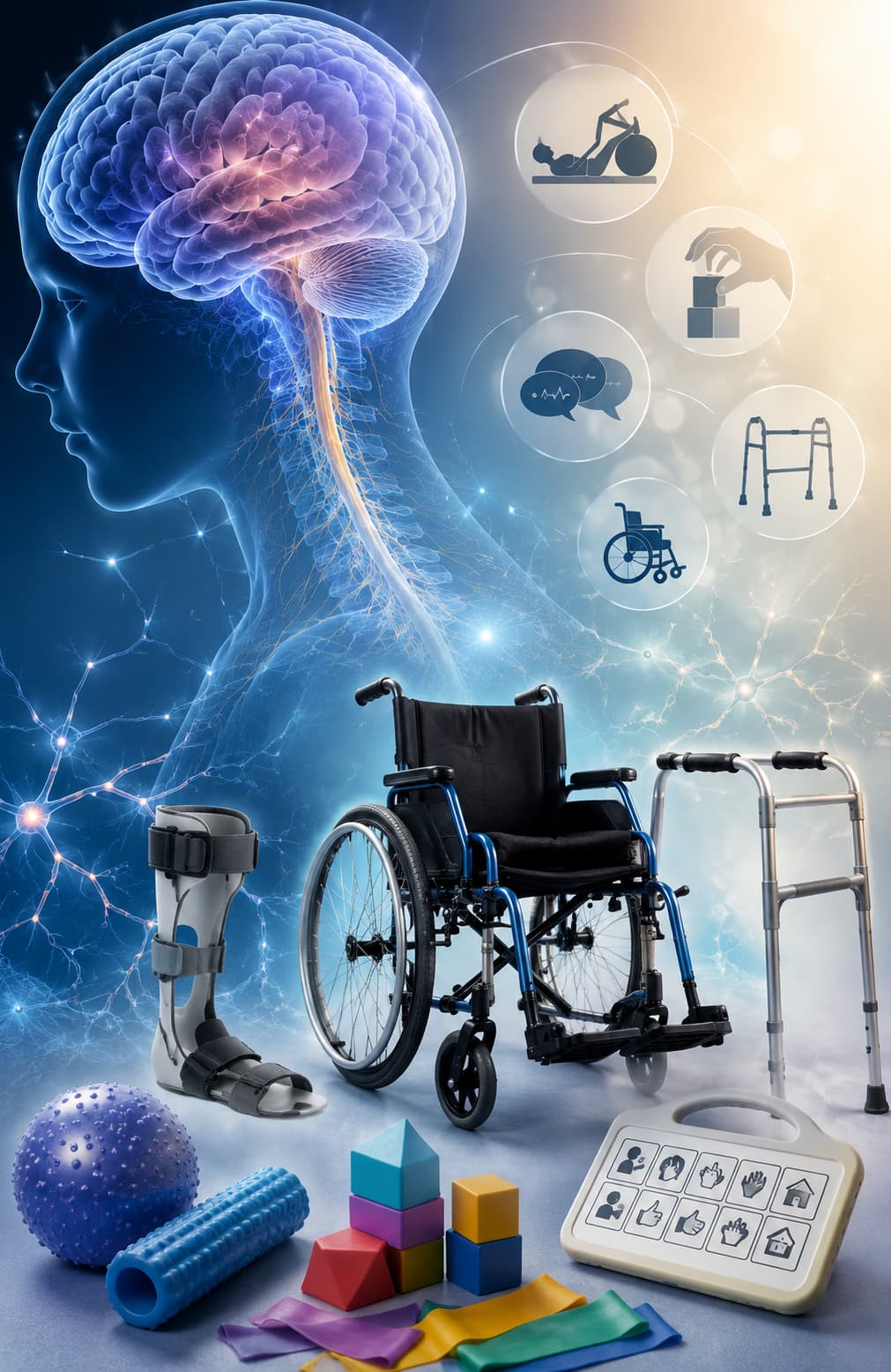
Ankle-foot orthoses and other braces may help with positioning, joint stability, walking, or maintaining range of movement. Walkers, crutches, standing devices, manual wheelchairs, and powered wheelchairs can improve mobility and access to school, work, recreation, and community life.
Equipment is not a sign that therapy has failed. A wheelchair, for example, may allow someone who can walk short distances to travel farther, conserve energy, and participate more fully in daily activities.
Other helpful technology may include adapted seating, bathing equipment, computer controls, communication devices, environmental controls, and modifications to homes, schools, or workplaces. Equipment should be reviewed as a child grows or as an adult's needs change (2).
How Are Feeding and Nutrition Problems Managed?
Some people with cerebral palsy have difficulty chewing, swallowing, or eating enough food. Muscle and movement problems can make meals slow and tiring. Reflux, constipation, pain, or other digestive problems may also affect nutrition (6).
A speech and language therapist may assess swallowing and recommend safer food textures, drinking methods, positioning, or feeding techniques. A dietitian can assess growth, nutrition, fluid intake, and whether the diet provides enough energy and nutrients.
Some people cannot safely or reliably meet their nutritional needs by mouth. In these situations, tube feeding may be considered. A gastrostomy tube delivers nutrition directly into the stomach. The decision is individualized and should consider nutrition, swallowing safety, comfort, family circumstances, and quality of life (6).
Nutritional needs can be different from those of people without cerebral palsy, particularly when mobility is limited. Regular assessment is therefore more useful than assuming that standard calorie estimates are appropriate for everyone.
What Other Health Problems Need Treatment?
Cerebral palsy can occur with other health problems that may have as much effect on daily life as the movement disorder itself. These problems should be actively identified and treated rather than regarded as unavoidable parts of cerebral palsy (1).
Epilepsy may require anti-seizure medicines. Pain can result from muscle spasms, hip displacement, joint problems, reflux, constipation, dental problems, or other causes and should be investigated rather than automatically attributed to cerebral palsy.
Vision and hearing difficulties may need specialist treatment or assistive devices. Sleep problems, constipation, reflux, bladder problems, low bone density, breathing problems, and dental difficulties may also require treatment.
Mental health is important as well. Children, teenagers, and adults with cerebral palsy can experience anxiety, depression, social isolation, or stress. Access to education, recreation, relationships, employment, and community participation forms an important part of long-term health and well-being.
Does Cerebral Palsy Treatment Continue in Adulthood?
Cerebral palsy is lifelong, so health care should not stop when pediatric services end. Adults may develop new problems even though the original brain injury remains non-progressive. Years of altered movement can contribute to pain, fatigue, arthritis, reduced mobility, muscle tightness, and other musculoskeletal problems (1).
Some adults who walked independently when younger find that walking requires more energy with age. Others may need different equipment or changes to therapy. Maintaining physical activity, monitoring pain and joint problems, and reviewing mobility needs can help preserve function.
Transition from children's services to adult health care should therefore be planned. Adults with cerebral palsy may need access to primary care, rehabilitation, neurology, orthopedic care, pain management, nutrition services, mental health support, and other specialists according to their individual needs.
Conclusion
Cerebral palsy treatment is not based on one medicine, therapy, or operation. It is an individualized, lifelong approach that aims to improve function, comfort, communication, independence, and participation. Active, goal-directed rehabilitation is central to care, while medicines, injections, surgery, assistive technology, and treatment of associated health problems are used when needed. Regular review is important because needs change with growth and aging. The most useful treatment plan is one that focuses on the person's own goals and supports participation in everyday life rather than treating muscle tone or movement problems in isolation.
References
- Novak I, Jackman M, Finch-Edmondson M, Fahey M. Cerebral palsy. Lancet. 2025;406(10499):174–188. https://doi.org/10.1016/S0140-6736(25)00686-5
- Jackman M, Sakzewski L, Morgan C, et al. Interventions to improve physical function for children and young people with cerebral palsy: international clinical practice guideline. Dev Med Child Neurol. 2022;64(5):536–549. https://doi.org/10.1111/dmcn.15055
- Faccioli S, Pagliano E, Ferrari A, et al. Evidence-based management and motor rehabilitation of cerebral palsy children and adolescents: a systematic review. Front Neurol. 2023;14:1171224. https://doi.org/10.3389/fneur.2023.1171224
- Fehlings D, Agnew B, Gimeno H, et al. Pharmacological and neurosurgical management of cerebral palsy and dystonia: clinical practice guideline update. Dev Med Child Neurol. 2024;66(9):1133–1147. https://doi.org/10.1111/dmcn.15921
- McGrath TM, Palmer ST. Integrated hip surveillance pathways for pain, function and quality of life in children with cerebral palsy: a systematic literature review. Eur J Paediatr Neurol. 2024;53:166–173. https://doi.org/10.1016/j.ejpn.2024.10.012
- Oftedal S, McCormack S, Stevenson R, Benfer K, Boyd RN, Bell K. The evolution of nutrition management in children with severe neurological impairment with a focus on cerebral palsy. J Hum Nutr Diet. 2025;38(1):e13277. https://doi.org/10.1111/jhn.13277
This article is part of the 'Public Education Series' initiative by Exon Publications.
Disclaimer: This article is for general educational purposes only and does not constitute medical advice, diagnosis, or treatment. Consult a qualified healthcare professional about personal health concerns.
Note on External Links: External links were checked and accessible when this article was published. Their content and availability may change over time and are outside the control of Exon Publications.
Downloads
Article Details

This work is licensed under a Creative Commons Attribution-NonCommercial-NoDerivatives 4.0 International License.